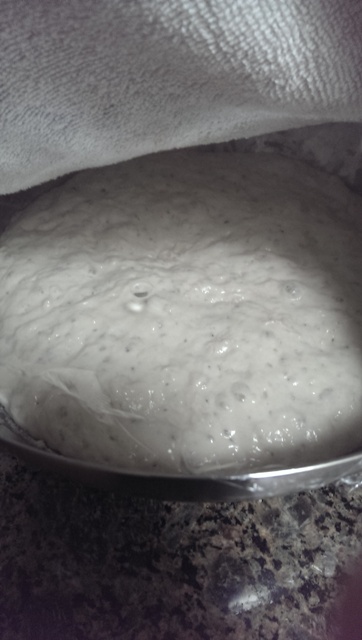
White bread – Richard Bertinet slap/fold

Over this last year when I first started getting into this baking business I was following the recipes based on their volume measurements (cups, Tbsp, tsps).  As I’ve researched and learned more about bread making, I realized that you often need to rely more on weight measurements when putting the ingredients together.

I invested in the Ozeri Digital Kitchen Scale.  This has helped me more accurately measure out ingredients.

This week I went for a basic white bread recipe and used the following recipe:

  • Bread flour 100% (500 g)
  • Water 66% (330 g)
  • Salt 2% (10 g)
  • Yeast 0.36% (1 g)
  • Added more water, suspect ~70% hydration

I followed Richard Bertinet’s slapping and folding method (here) to work the dough after the initial mixing.  I like this method because  you don’t need to use additional flour when kneading the dough and getting it to come together.  The engineer/math side of me says this makes sense because the recipe calls for a certain amount of flour.  If you’re using additional flour when kneading, then this throws off the original recipe.

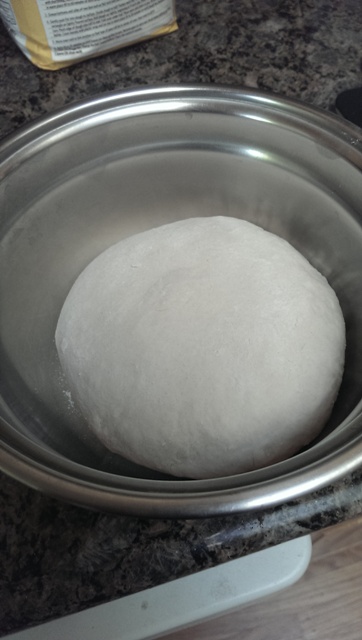
I wasn’t sure how long I was supposed to do the slap and fold method.  In the video, Richard talks about continuing the slap and fold method until the dough is no longer sticky to the touch.  I think that I went a little overboard on how long I did this for.  I slapped and folded that dough for upwards of 45 minutes.  But here is the result:
IMAG2600
After slapping and folding

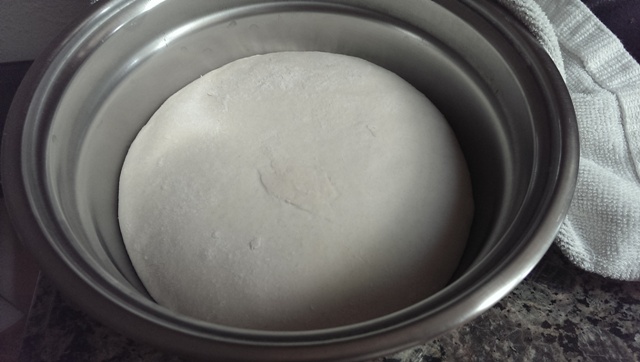
Then I let it rise for a little over an hour (the house was in the high 60s, so a little cool).
IMAG2601
After rising

One thing I did for the first time, again after watching Richard’s video above is some simple folding and shaping prior to splitting the dough up into individual pieces.

My goal for this day was to make a loaf using a loaf pan and also possible a boule (round loaf).  Now I wasn’t sure how much dough I needed to fit into the loaf pan that we have (9 x 5).  I looked online and some people were recommending something like 800-1200g.  My dough in total was maybe 700g.  I ended up making a small boule and using about 500g for the loaf pan.

After letting it proof (I think I may not have proofed it long enough), the loaf pan was hardly filled.
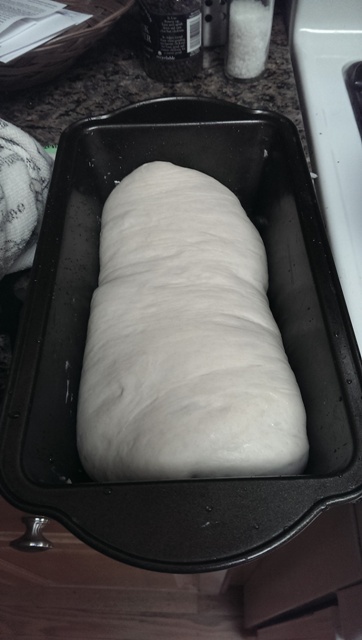
IMAG2609

Next time I will have to use the proper amount of dough to fill the pan.  I pre-heated this Lodge enameled cast-iron dutch oven in a 450 degree oven with the lid off.  Pre-heating will help prevent sticking of the bread to the bottom (my mistake the first time using this dutch oven included letting it proof in the dutch oven).

I cooked the bread at 450 F for 10 minutes, removed the lid and lowered the temperature ot 375 and cooked for another 20 minutes.  I did check the bread with my digital thermometer and found it to be around 210 F, which indicates it is finished.  I hope to one day be able to just visualize and feel the bread to know it is finished so I don’t have to put a hole in the bread with the thermometer.  Finished product below:

I was overall happy with the taste of the bread and used the loaf as scarpetta for a chicken masala (sliced the bread and made garlic bread = replacement for garlic naan).  The crumb was a little tight but worked out for the slices that we made from them.
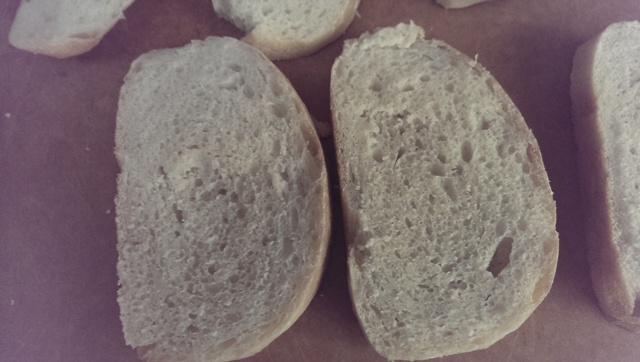
IMAG2616

All in all I was happy with this.  Next up – rustic artisan bread (or that’s the plan at least)

-StewsCat


No-knead pizza dough

I’ve been making pizza from scratch now for a little over a year.  I started by doing a search for no-knead bread/pizza dough because I wanted something simple that also didn’t require a lot of technical expertise.  I’ve been delving into the science behind baking and yeast and all that jazz.  My pizza dough has been evolving over the last year.  Sometimes the dough is too soft and pliable, sometimes it is thicker.  I believe I’ve found a good compromise between the no-knead method and some folding/shaping that provides a decent amount of structure to the dough.

I start with Jim Lahey’s no-knead recipe.  After reading some other blogs, I added in more salt than the original recipe  mostly because the original is underseasoned and Jim Lahey himself pretty much admitted that it could use more salt.

  • 500 grams (3-4 cups) all-purpose flour, plus more for shaping the dough
  • 1 gram (1/4 teaspoon) active dry yeast
  • 16 grams (2 teaspoons) fine sea salt
  • 350 grams (1 ½ cups) water

I recently bought a digital kitchen scale so have been using weight (instead of measured cups) to create my dough recipes.  I think this is a more accurate method and have had good results with this compared to going by the other measurements.

I combine the above ingredients into a mixing bowl, make sure it is all well incorporated and let it sit overnight (12-18 hours) at room temperature.  This method doesn’t require the normal kneading (10-20 minutes) because as the yeast work on the flour and create the gases, they also are kneading themselves (this is why you have to let it sit for so long).

IMAG2592
Flour, water,  yeast, salt – the night before

The next day you have this risen dough full of gas.

IMAG2593
The next day (full of gas)

Rather than just shaping this into the dough balls for pizza (as in the original recipe), I poured the mixture out onto a floured surface.  Here I then stretch the dough in all directions while lightly degassing it.  Then I fold the dough in thirds horizontally (like an envelope), then vertically in thirds, flip the dough, then place it back into the bowl for another 45-60 minutes.  I repeated this process twice and each time you can feel the dough firming up and getting more structure.

IMAG2594
Ready to roll out into pizza


As in the picture above, I then divided the dough into 4 and shaped 2 of them into balls (the other 2 I shape into balls, wrap in plastic then freeze).  I then let these dough balls proof for another 30-45 minutes.

After reading about the various ways to roll out, toss, twirl pizza dough, I’ve come up with a method that works for me.  I take the ball and put it on a lightly floured surface.  Then flatten the dough out and run my fingers about 1 inch from the edge of the dough flattening the dough in the center of the ball and lightly stretching it out into a disc shape.  I continue this around the entire circumference of the dough.  Then I hold one end (the right side) with my right hand and use my left hand to stretch the left side of the dough disc.  Flip the dough over and stretch the right side.  Continue until the disc is stretched out.  At this time you can then pick up the dough and using your knuckles continue to stretch and thin out the dough – leaving the outer 1 inch edge alone so that it forms a night puffy crust.

I make a simple tomato sauce for my pizza using canned San Marzano tomatoes, some basil and some garlic.  Sometimes I’ll add in some tomato paste to thicken up the sauce.

I usually top the pizza with some combination of mushrooms, zucchinis, prosciutto, and/or pepperoni.

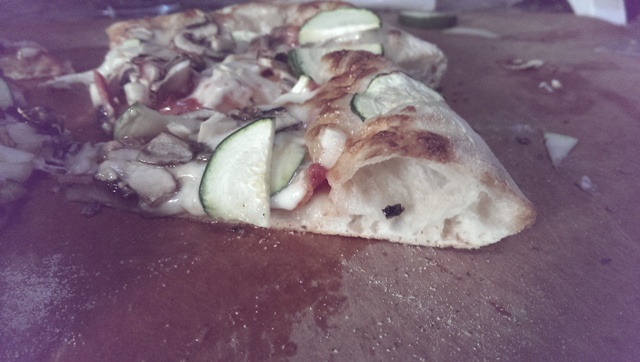
This last time I managed some good air pockets in my crust.

IMAG2598
Big air pockets in the curst

Bon Appétit!

-StewsCat